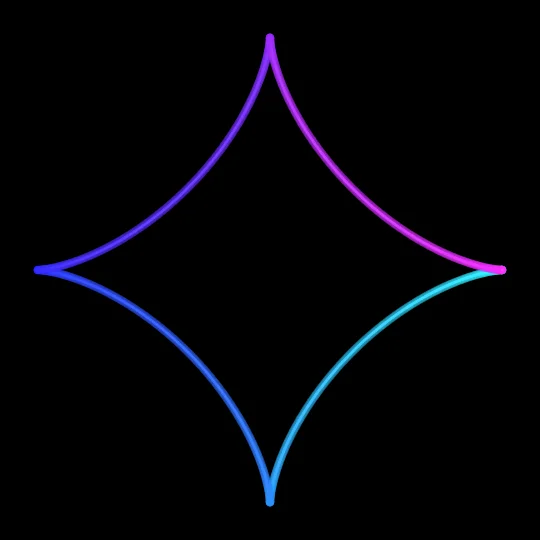
Hypocycloids
Curves traced by a point on a small circle rolling inside a larger one. The r/R ratio decides whether you get deltoids, astroids, or spirographs.
Gallery
The most recent works saved in Studio.
Catalogue
Every video starts from one of these mathematical systems, drawn in real time in the browser.
Curves traced by a point on a small circle rolling inside a larger one. The r/R ratio decides whether you get deltoids, astroids, or spirographs.
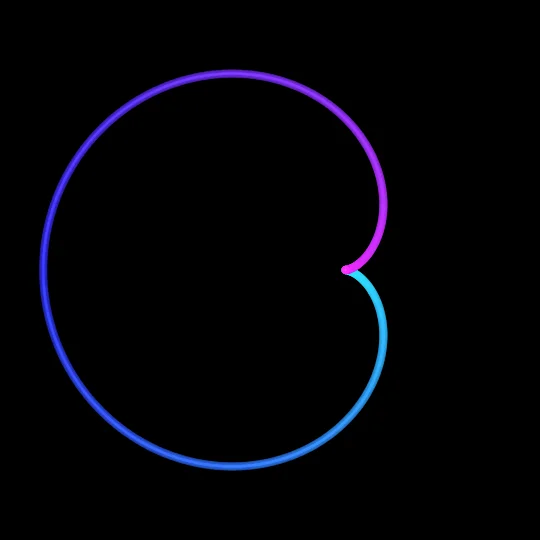
A circle rolls along the outside of another: the tracked point draws cardioids, nephroids and other elegant curves found in optics and mechanics.
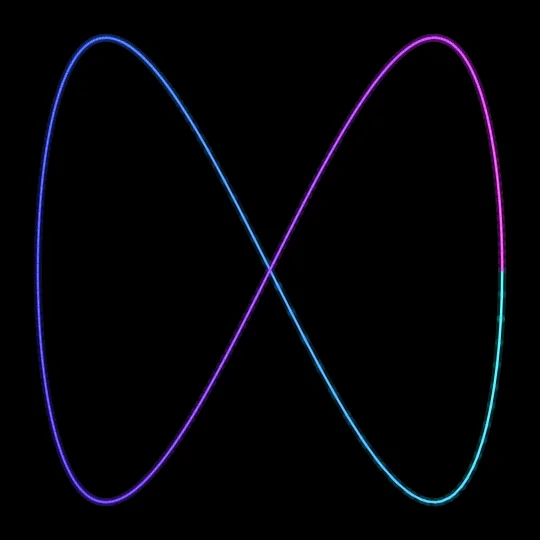
Two perpendicular oscillations combined. The frequency ratio and phase determine shapes from simple ellipses to intricate woven knots.
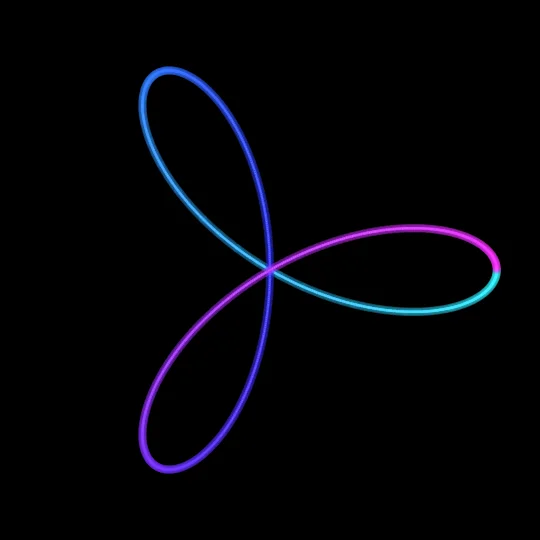
Polar curves of the form r = cos(kθ): symmetric petals whose count depends on the parity of k. Mathematics draws exact flowers.
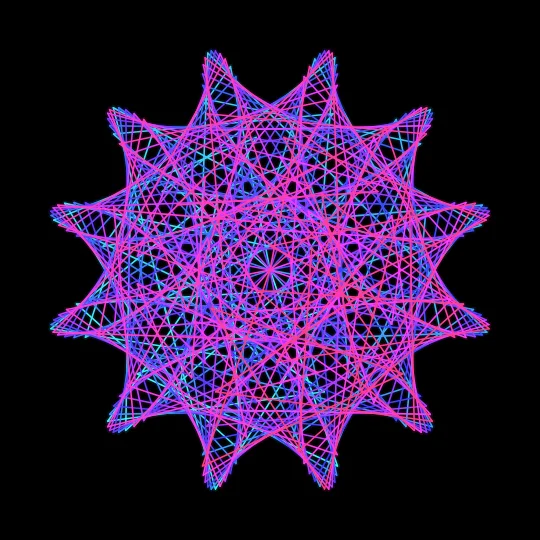
A polar rose sampled at regular intervals, with points joined by straight lines. Hidden moirés and symmetries emerge from the numbers.
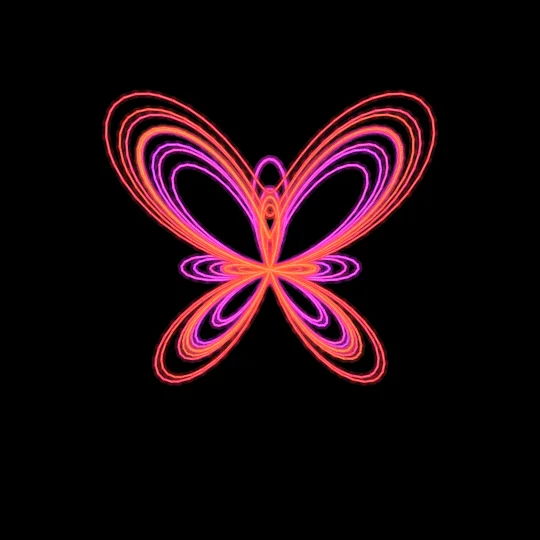
Fay's transcendental curve, expressed in polar coordinates with exponentials and sines. A mathematical butterfly from a single equation.
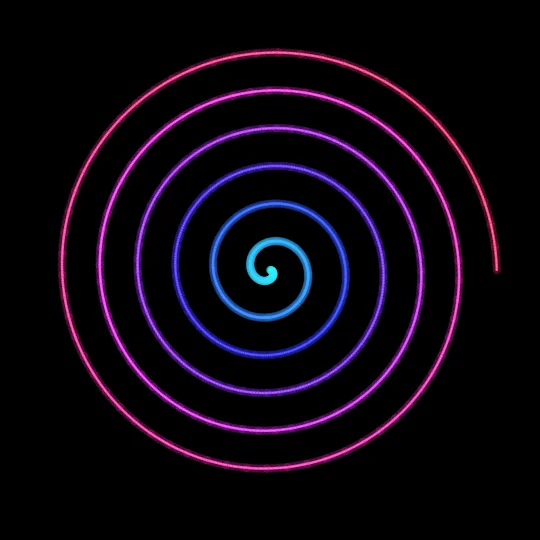
Archimedean, logarithmic, Fermat, Cornu: each spiral has its own radial growth law, from the seashell to the clothoid transition curve.
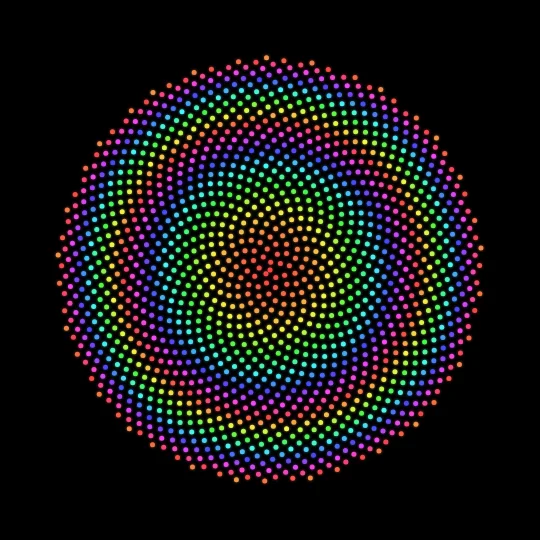
Sunflower seeds placed at the golden angle (137.5°) with radius √n. The same algorithm nature uses to pack seeds optimally.
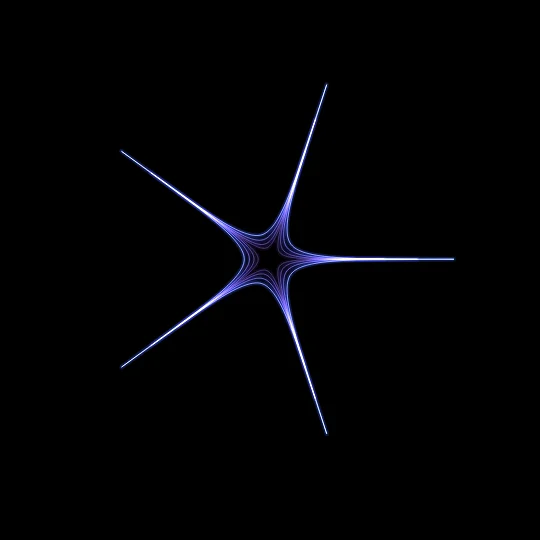
The Gielis superformula (2003): a single polar equation that, by varying four parameters, generates starfish, diatoms, flowers and shells. Its continuous metamorphosis shows how many living forms share the same mathematics.

A line stretched between two real planets, drawn every few days for years: nobody traces the figure, the figure is the edge the lines never cross. Earth and Venus line up five times every eight years and leave a pentagram behind; on true ellipses, though, it never closes the same way twice.

A planet's path seen from Earth instead of from the Sun: subtract two orbits and the ellipse turns into a rosette of loops, because at every overtaking the planet appears to go backwards among the stars. These are the loops that kept epicycles alive for fourteen centuries.

The Sun does not sit still in a focus: the barycentre does, and the Sun circles it, dragged by the planets. Jupiter alone shifts it by 743,000 km, a little over one solar radius; adding the other giants turns the motion into a looping figure that crosses the star's own surface. It is the wobble that found the first exoplanets.

Resonance chains drawn whole: one chord for every adjacent pair of moons, and the envelopes nest. Io, Europa and Ganymede are held by the Laplace resonance and their figure closes exactly; the Venus rose, a mere coincidence of periods, drifts a little every turn.
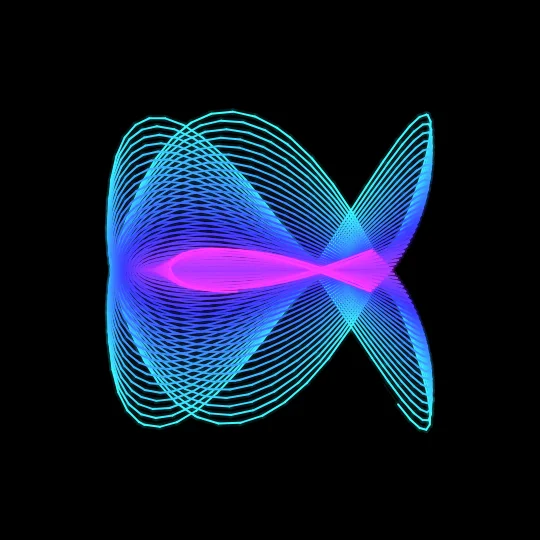
Damped pendulums oscillating against each other: evolving Lissajous figures that slowly fade as friction takes over.
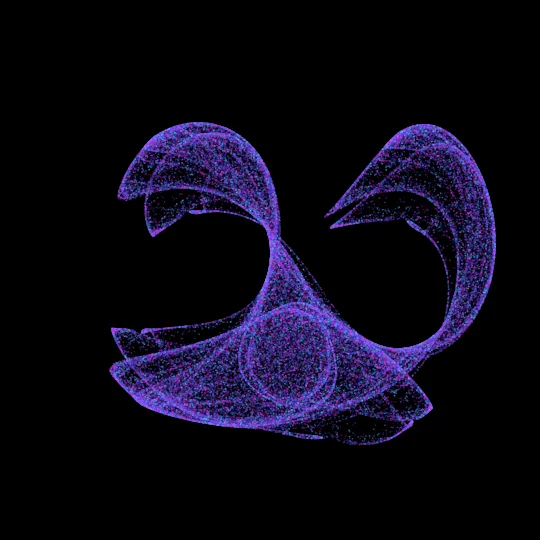
Strange attractors: chaotic trajectories that never repeat, yet stay confined to fractal structures: order within disorder.
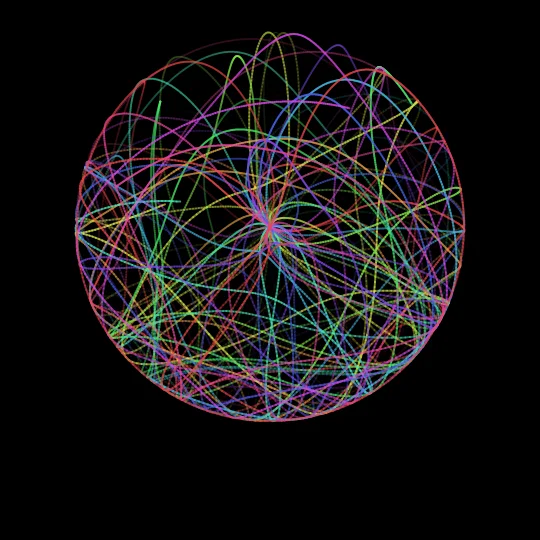
The hallmark of chaos theory: two rods joined by a pivot. Tiny differences in starting conditions produce wildly divergent paths.
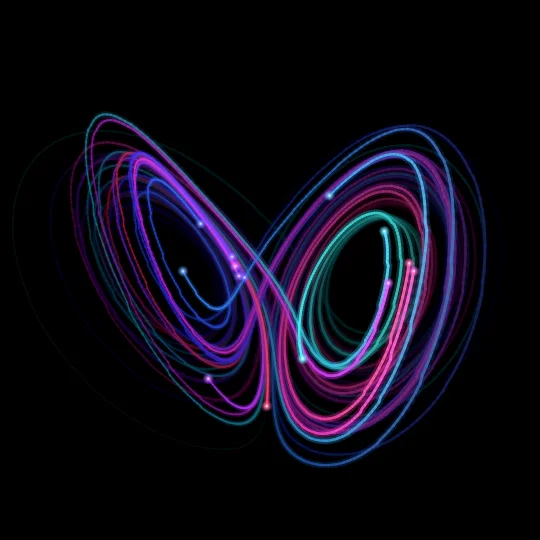
The Lorenz attractor, the butterfly of chaos theory: nearly identical trajectories tear apart within seconds, yet stay trapped on the same two wings. Deterministic, never repeating.
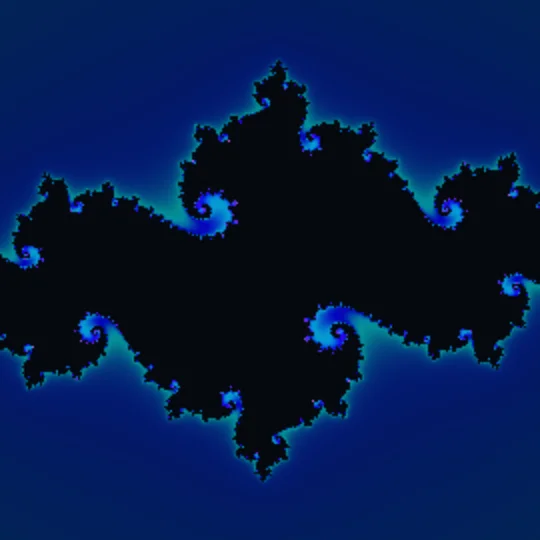
A morphing Julia set: the parameter c travels a closed orbit in the complex plane while z → z² + c folds and unfolds infinite filigree, looping seamlessly.
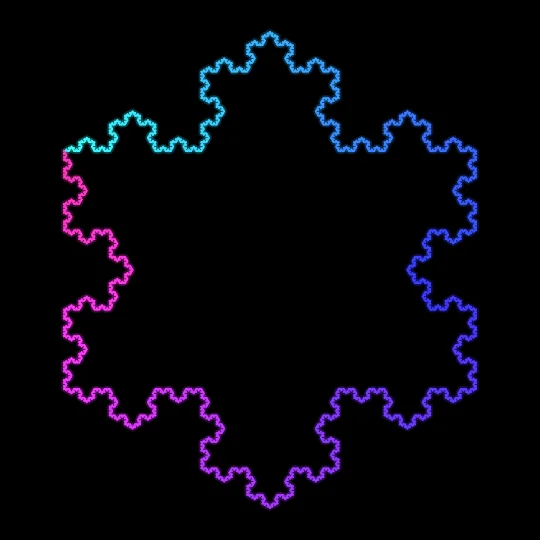
Recursive fractals generated by Lindenmayer systems: simple rules produce trees, snowflakes and space-filling Hilbert curves.
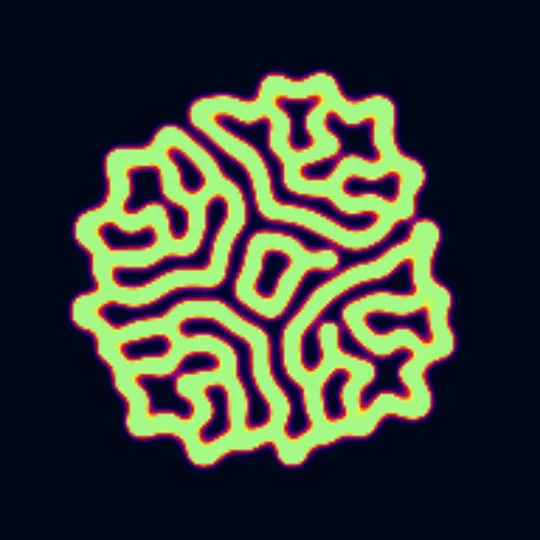
Gray-Scott reaction-diffusion: two chemical species U and V that interact to grow spots, mazes, coral and waves, the Turing patterns of 1952.
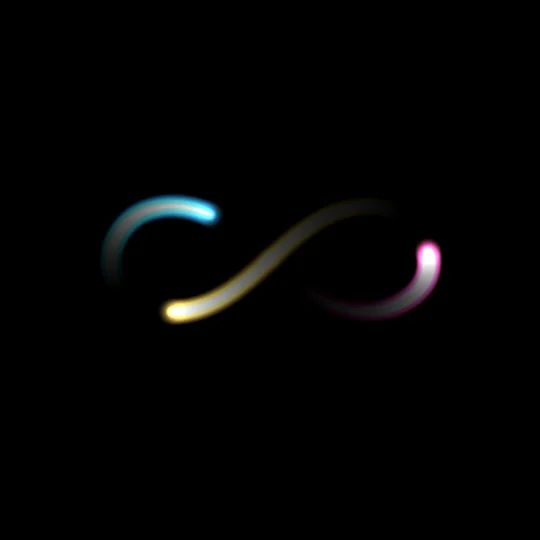
The three-body problem: three masses in mutual gravitational free-fall, from the perfect Chenciner-Montgomery figure-eight to Burrau's chaos. No closed formula solves it: only numerical integration reveals its choreographies.
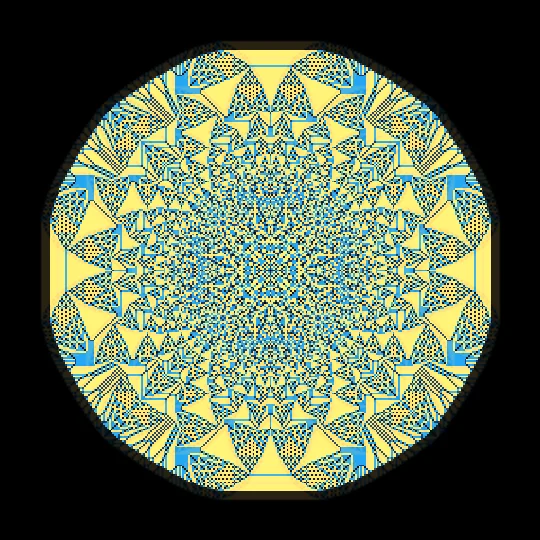
The abelian sandpile of Bak, Tang and Wiesenfeld: grains dropped one by one onto a grid; any cell reaching 4 topples onto its neighbours, unleashing avalanches at every scale. Out of the chaos grows a perfectly deterministic fractal mandala (1987).
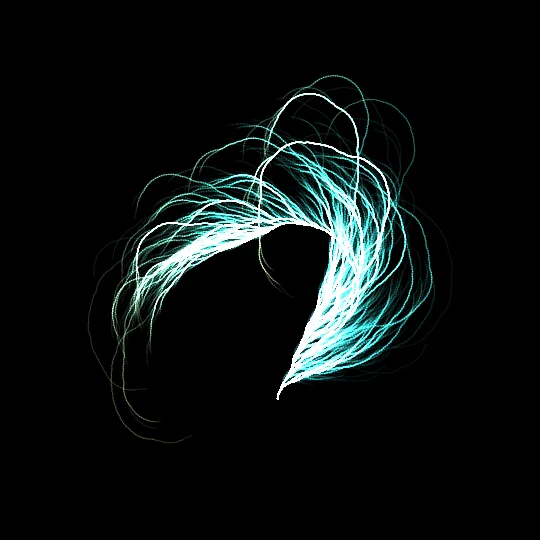
Thousands of Collatz (3n+1) sequences retraced backwards from 1: even turns clockwise, odd counter-clockwise, and shared prefixes redraw the same trunk until a glowing coral emerges. A conjecture open since 1937.
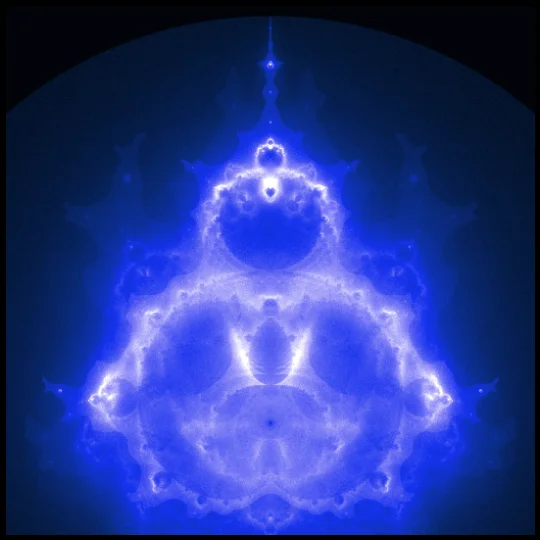
The Buddhabrot: every orbit escaping z² + c deposits its whole path into a density map. Millions of orbits later, a seated luminous figure emerges from the noise. A live Monte Carlo render (Melinda Green, 1993).
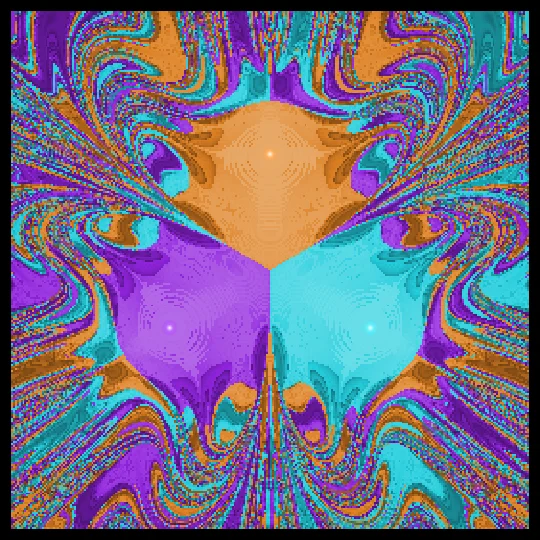
A pendulum over three magnets: which one will capture it? Every pixel is a starting point, coloured by the answer. A fractal map emerges with endlessly interleaved boundaries: Newtonian physics, unpredictable outcome.
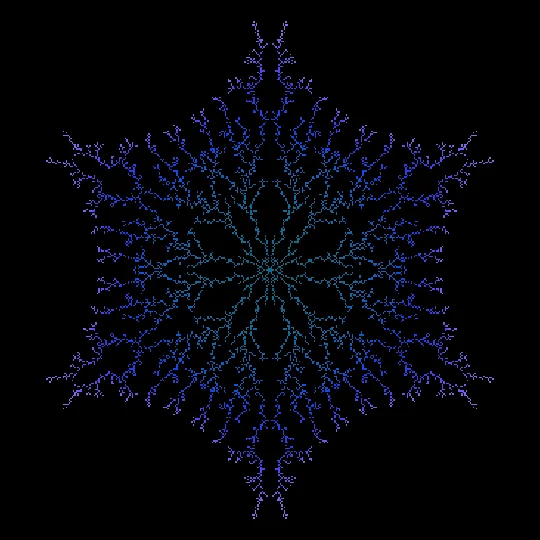
Diffusion-limited aggregation: Brownian particles freeze at first contact with the growing cluster. Three lines of rules and a fractal snowflake is born (Witten and Sander, 1981).
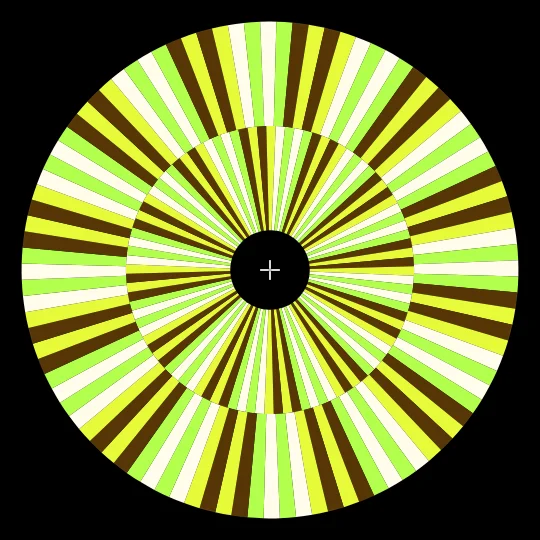
Rotating snakes, lilac chaser, café wall: static patterns the brain interprets as motion or distortion.
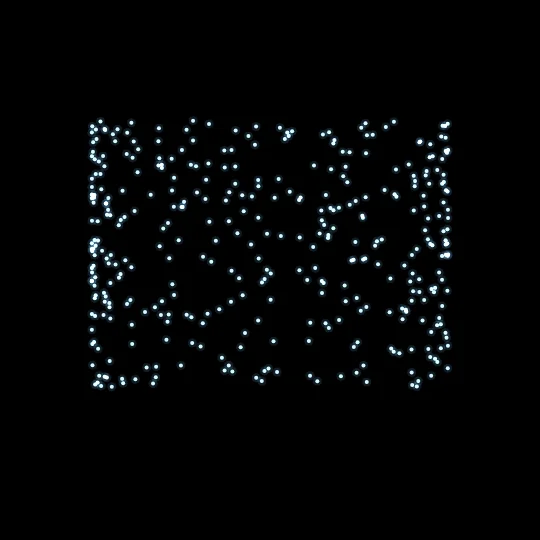
A cylinder of dots rotating with no depth cues: half of all viewers see it spin clockwise, the other half counter-clockwise — and both are right. Bistable perception: when the data underdetermines, the brain decides.
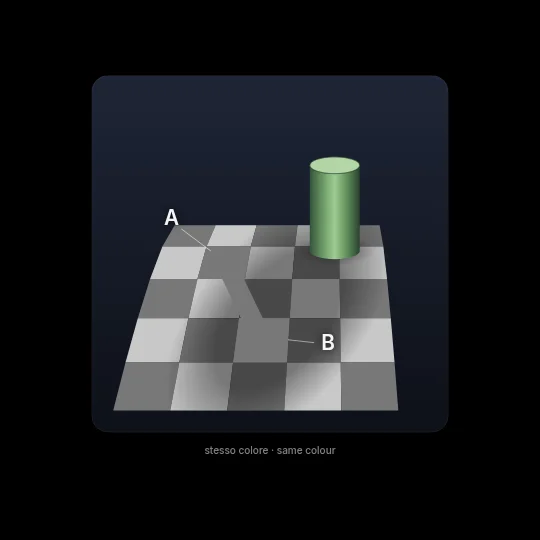
Two areas with the exact same RGB that look like different colours: Adelson's checker-shadow, simultaneous contrast, Munker-White spheres. When the animated proof connects them, the brain refuses to believe it: we don't see light, we see an interpretation.
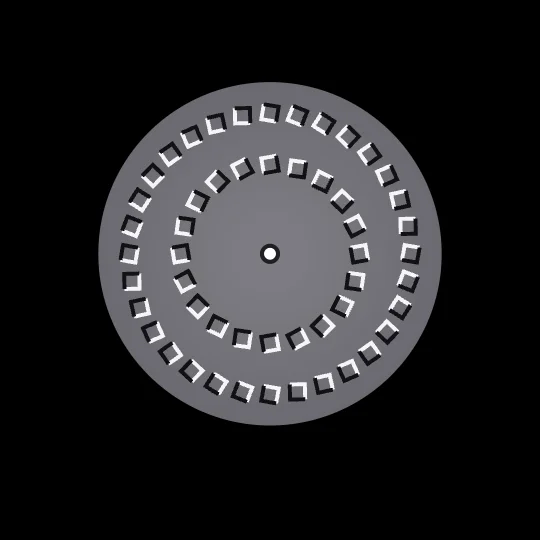
The Pinna-Brelstaff illusion: rings of tilted elements that seem to counter-rotate as the pattern zooms in and out. Yet physical rotation is exactly zero: only the scale changes, the rotation happens in your motion detectors (2000).
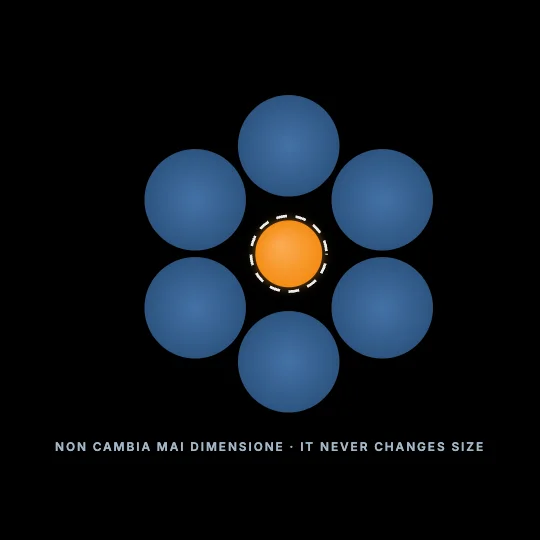
The dynamic Ebbinghaus illusion: the central circle never changes size, but as the surrounding circles swell and shrink it visibly seems to breathe. Mid clip a dashed reference ring proves it: context decides perceived size (1898).
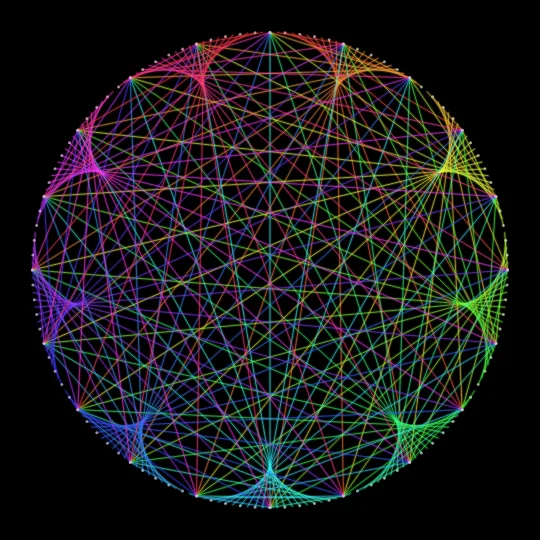
Points around a circle connected via modular times tables. From simple multiplication mod n, cardioids, nephroids and mandalas emerge.
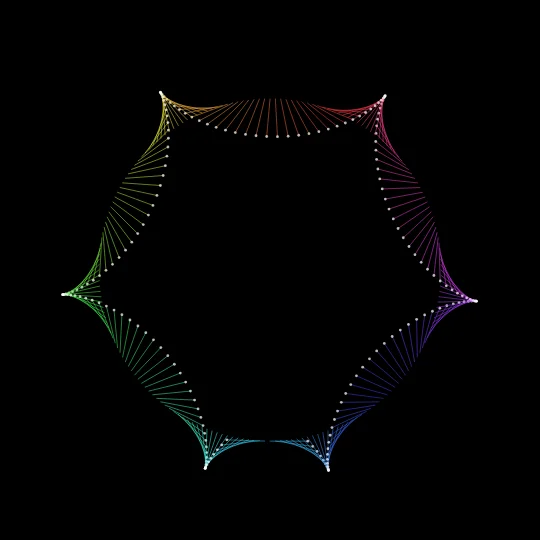
Two hundred parametric lines chasing each other as k morphs: from a singular point emerge triskelia, mandalas and multi-fold fans.
Circular waves adding and cancelling. Where crests meet, bright fringes; where they oppose, silent nodes.
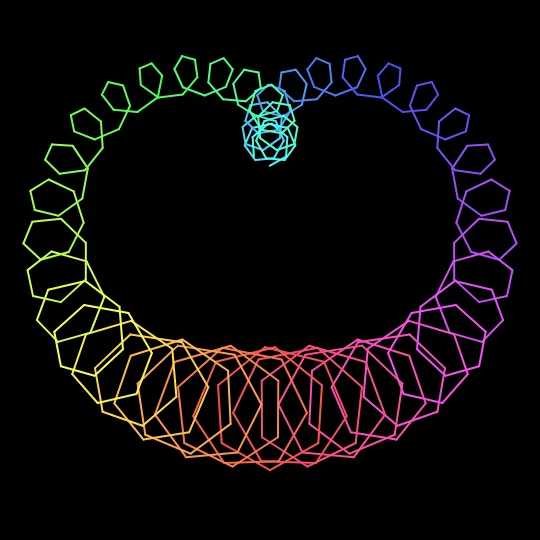
Any periodic motion is a sum of rotating circles. Fourier's theorem made visible, in real time.
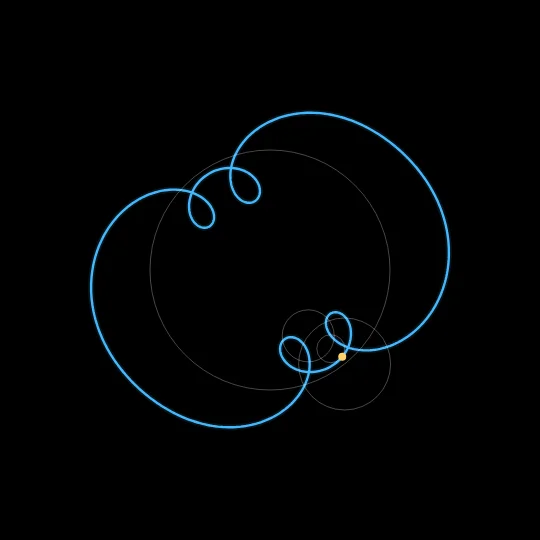
Drawing any icon by composing dozens of rotating epicycles. Fourier's theorem reconstructs the signal point by point.
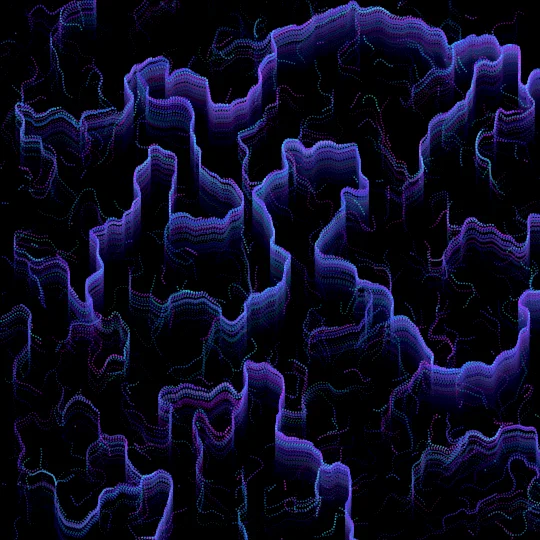
Particles carried by a Perlin-noise field. Chaos becomes flow, flow becomes brushstroke.
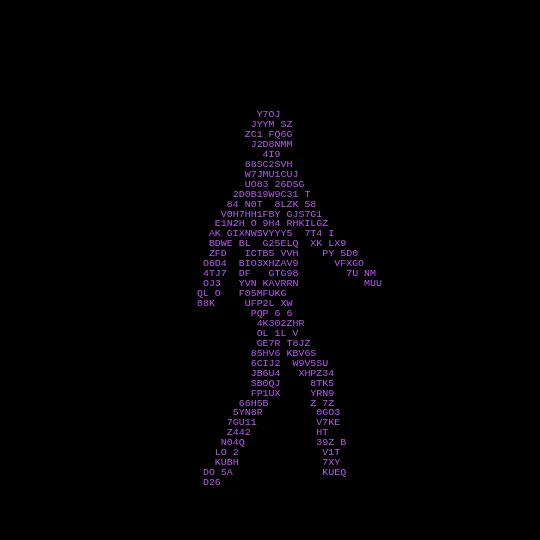
A walking human figure made of letters and digits, animated frame by frame. Typography in motion.
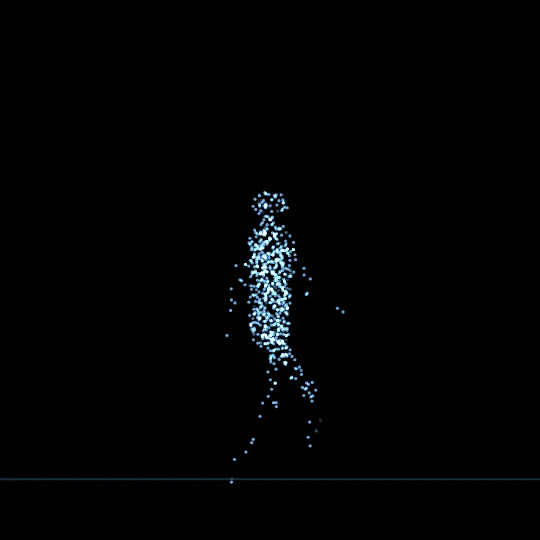
A walk composed entirely of particles: the silhouette appears only where orbits cross.
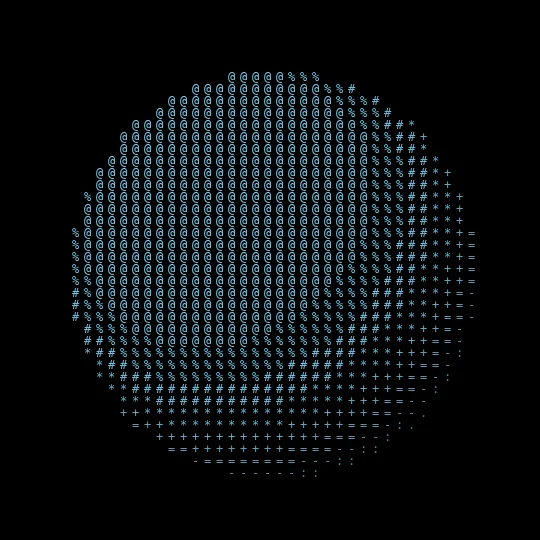
An image converted to typographic characters: pixel luminance maps to glyph density.
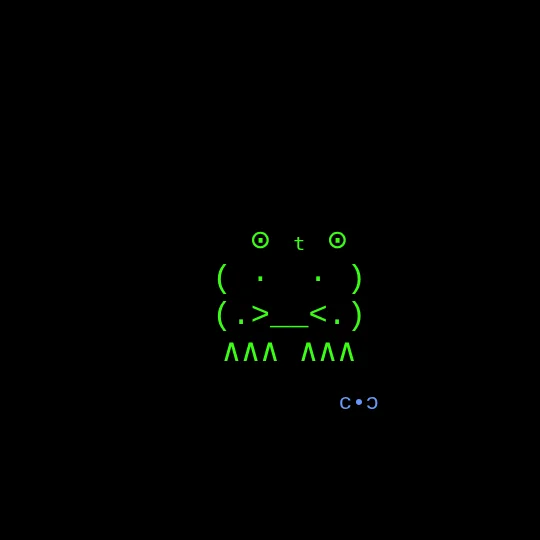
An ASCII frog catches flies with its tongue. Minimal animation inspired by the typographic culture of the web.
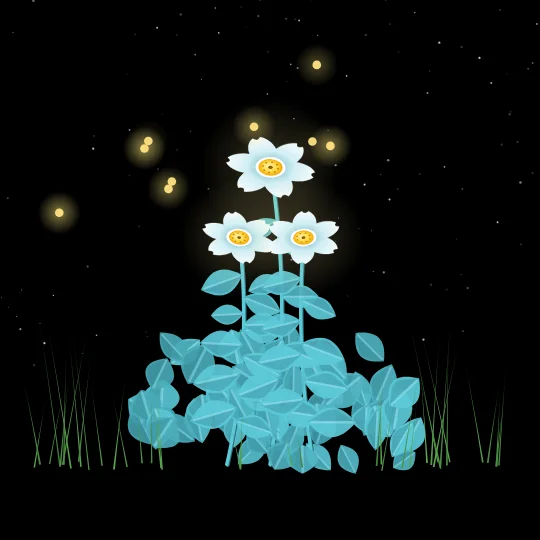
A procedural garden blooming in the night: stars, stems, leaves, petals and grass emerge in sequence while fireflies dance over the finished scene.
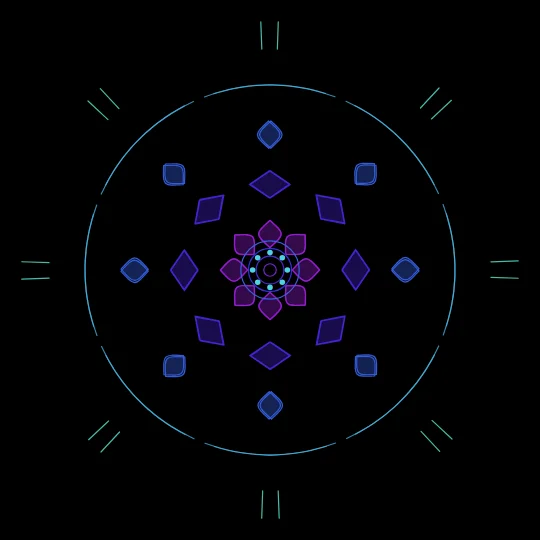
Mandala with n-fold radial symmetry: each ring picks a motif (spoke, arc, petal, diamond) and the figure replicates around the centre, with optional mirroring for full dihedral symmetry.
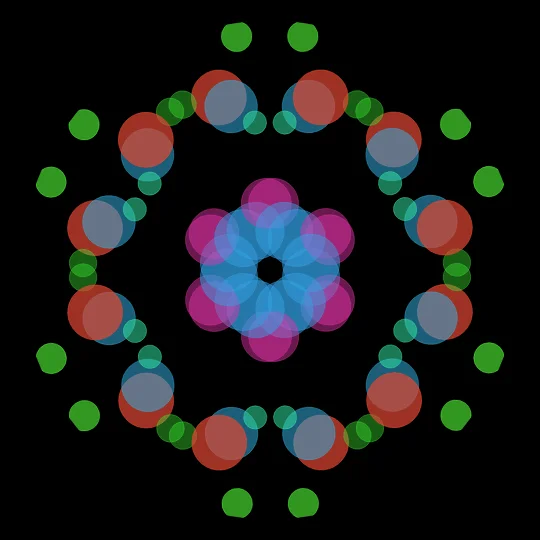
A kaleidoscope: three angled mirrors multiply a handful of colourful shapes into endless patterns. Projective geometry turned into play.
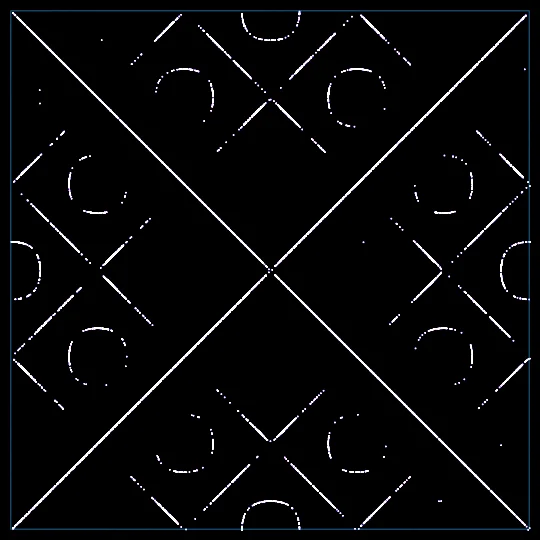
Chladni figures: thousands of grains on a vibrating plate flee the moving regions and settle along the silent nodal lines. At every mode change the sand snaps into a new symmetric figure (1787).
Physarum polycephalum: thousands of chemotactic agents deposit and follow a trail that diffuses and evaporates. From purely local feedback — sense, turn, deposit — a living filament network self-organises, the same web the slime mould uses to solve mazes.
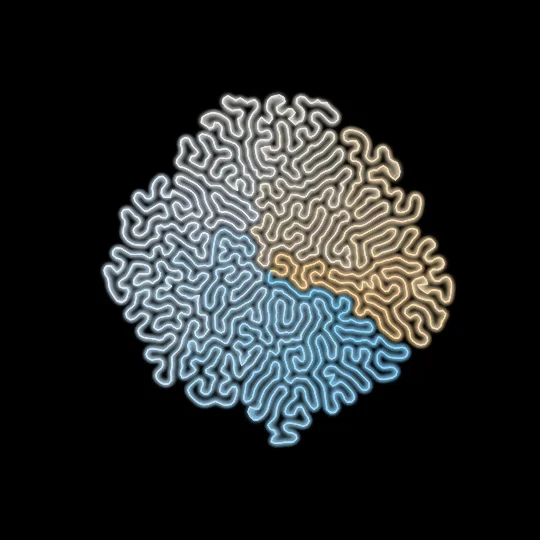
Differential growth: a closed curve feeds, stretches and folds onto itself under cohesion and repulsion forces. Node after node, coral-like lace emerges — the same morphogenesis that shapes living tissue.
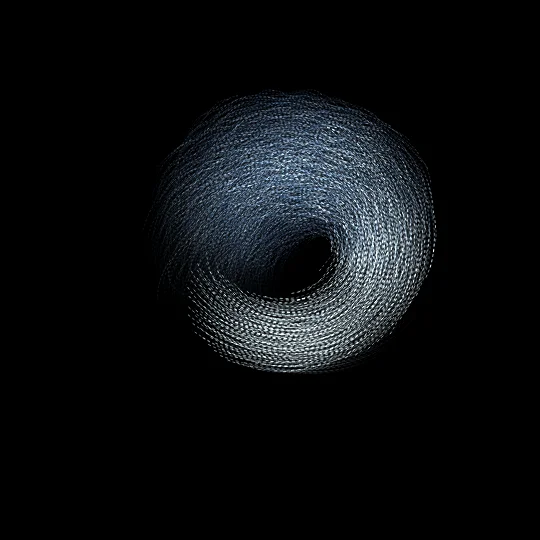
A leaderless starling flock: each bird follows just three local rules — separate, align, cohere with its neighbours — and out of nothing emerge the collective sky-dances of dusk. Reynolds' boids model (1987).
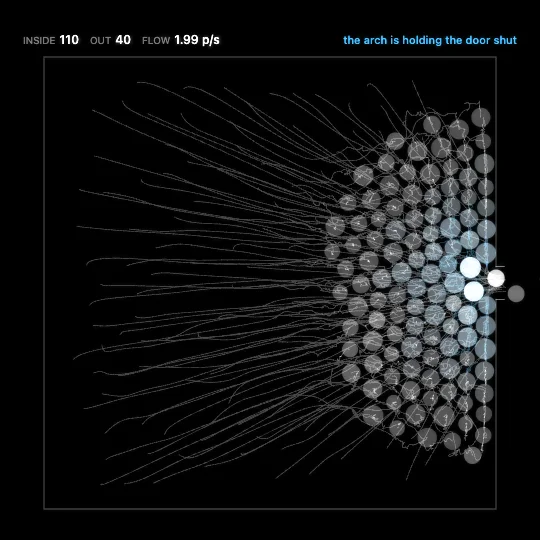
Helbing's social force model: everyone is pushed toward the exit and repelled by the people around them. Under pressure the crowd builds an arch of bodies in front of the door, and that arch is exactly what blocks the way out. A column planted beside the gap breaks it and gets more people out, not fewer (Helbing, Farkás and Vicsek, 2000).
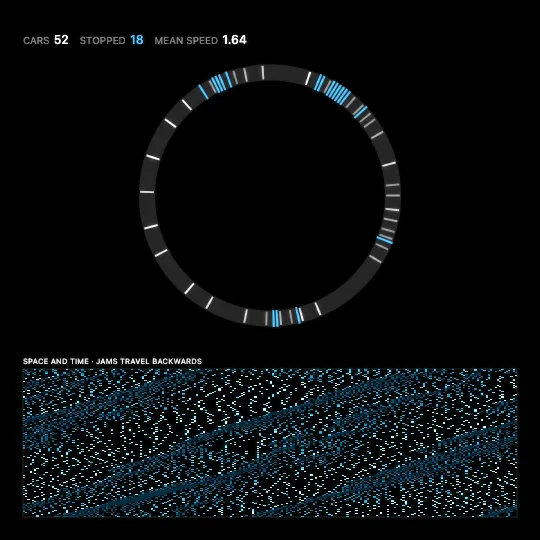
The Nagel-Schreckenberg model: a single lane closed into a ring, integer speeds, four rules per step. The third says a driver occasionally lifts off for no reason. That is enough: the car behind brakes harder, and a jam appears from nothing and travels backwards along the queue while every car keeps moving forwards (1992).
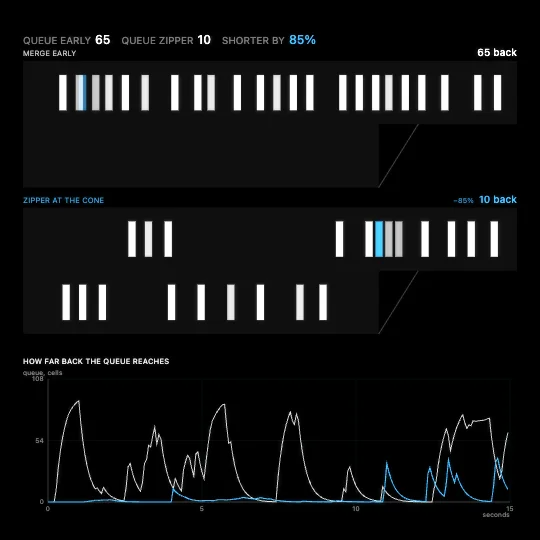
Two lanes dropping to one. Merging as soon as the sign appears on top, using both lanes to the cone and then taking turns below. Merging early feels courteous and looks orderly, but it throws away half the road: the queue in the through lane grows twice as long while the closing one sits empty. The flow past the cone is the same either way, because one lane has one lane's capacity: what the zipper halves is the tailback, and the tailback is what decides whether the queue reaches the junction behind.
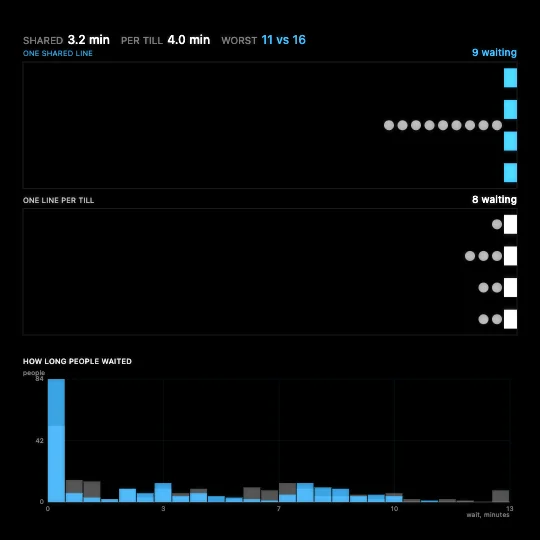
Four tills, same customers, same service times. A single shared line feeding every till on top, one line per till below. The averages end up close: what collapses with the single line is the tail of the distribution, because nobody gets stuck behind the full trolley while the next till sits idle.
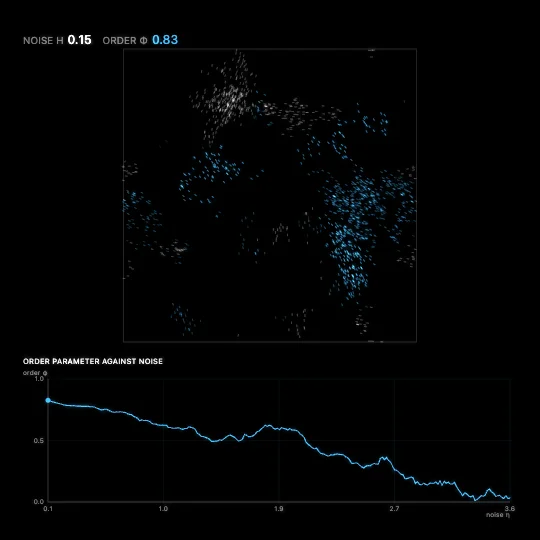
The Vicsek model: every particle moves at constant speed and takes the average direction of its neighbours plus a random kick of width η. Lower the noise and order does not grow gradually: it stays at zero, then snaps up. A phase transition with no leader, no plan and no signal, only noise dropping below a threshold (Vicsek et al., 1995).
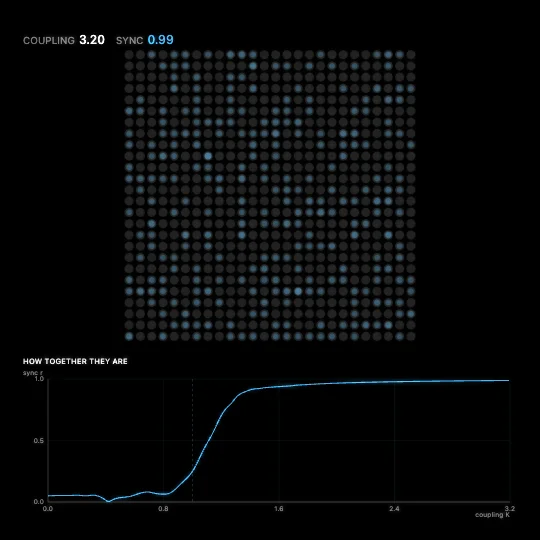
Kuramoto coupled oscillators, drawn as a field of fireflies. Each has its own natural rhythm and nudges the phase of the others. Below a critical coupling the field stays a mess of independent blinks; above it, they all lock. Nothing conducts them (Kuramoto, 1975).
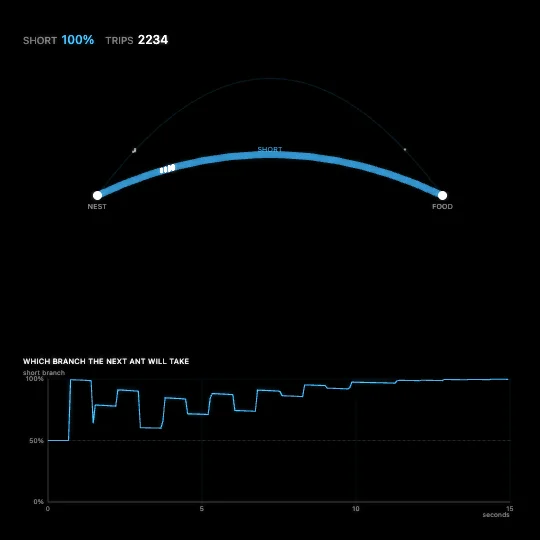
The double bridge experiment: a nest, some food, two branches of different length. Ants choose probabilistically by pheromone and lay more as they pass. Whoever takes the short branch gets back sooner, so lays sooner, so that branch smells stronger. Nothing measures the lengths: time does the arithmetic (Goss et al., 1989).
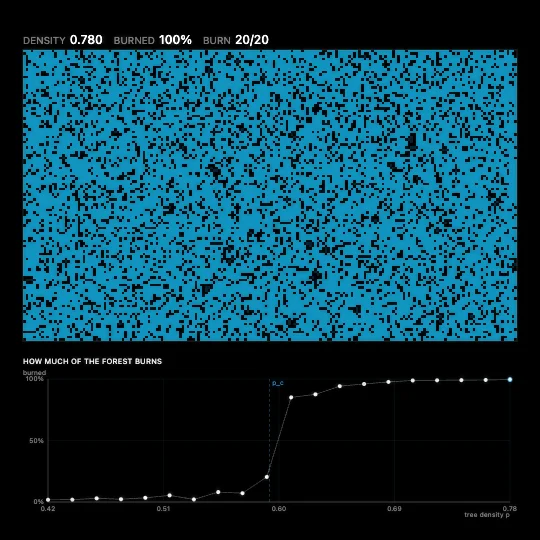
Site percolation: every lattice cell holds a tree with probability p and the fire starts from the left edge. Below the critical density the fire dies a few cells in, above it crosses the whole forest. There is no gradual middle: around p = 0.5927 the behaviour changes in kind, not in degree.
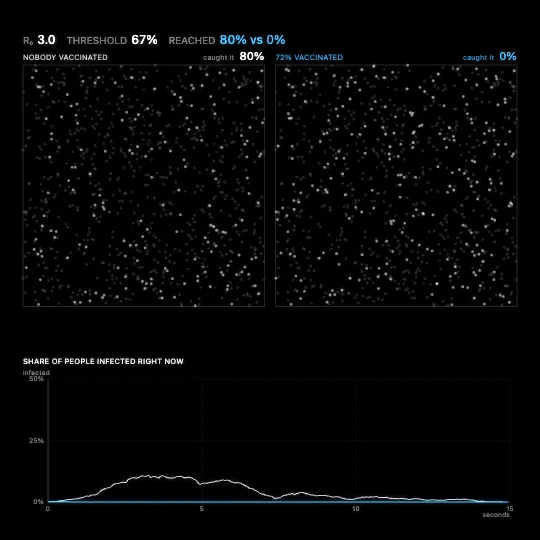
Agent-based SIR with spatial contact. Two identical populations, same patient zero: nobody vaccinated on the left, coverage just past the 1 − 1/R₀ threshold on the right. The counter-intuitive part is not that vaccination helps, it is that it does not need to cover everybody: past that line the epidemic cannot sustain itself and the unvaccinated are protected too (Kermack and McKendrick, 1927).
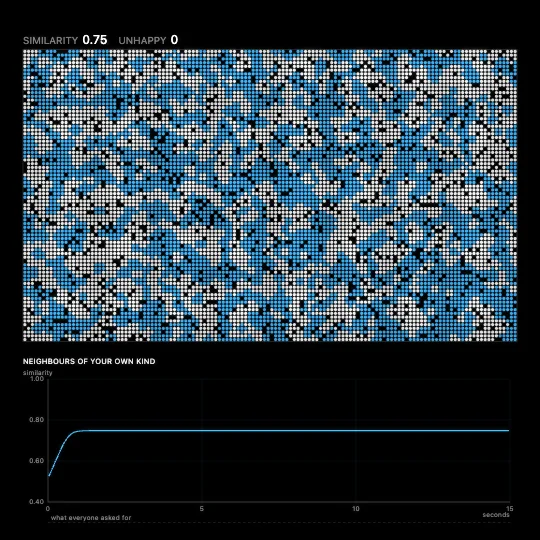
Schelling segregation: two kinds of agent on a grid, each content when a fraction of its neighbours are of its own kind. Set the threshold at 30 percent, meaning everyone accepts being in a seven-to-three minority, and the grid still separates into solid blocks. Mild individual preferences add up to a segregation nobody chose (Schelling, 1971).

Mathematical billiards: one ball, specular cushions, constant friction. The trajectory is computable in advance by unfolding the table instead of bouncing the ball, yet nobody watching can read it: count the cushions and call the pocket. From a bar game, Birkhoff carved out a whole branch of dynamical systems (1927).

The exact geometry of the Aug 12 2026 eclipse, the first total one over mainland Europe since 1999: the moon advances at constant speed and the covered fraction is the intersection area of two discs. The eye, though, compresses light with a power law: at 90% coverage it still looks like day, the last 1% switches the sky off in under a minute.

An orthographic Earth globe and the shadow of the Aug 12 2026 eclipse crossing it in 90 minutes: down from the Arctic, along Greenland's east coast, over Iceland at maximum (2m18s of totality at 17:46 UTC) and onto Spain minutes before sunset. The path is NASA's umbra ground track; the rest of Europe, Italy included, stays in a deep partial.